
AI infrastructure
Decide how much serving state to materialize, what the inference data plane costs to operate, and how retrieval-dependent outputs are evidenced.
HX-SDPThe Data Representation-Topology Company
Products, platforms and bespoke software & computational engineering
HolonomiX develops products, platforms and bespoke software through data representation and computational engineering. We design data structures, numerical operators and execution paths around accuracy, memory, latency and deployment requirements. Our work spans scientific computing, data platforms, cryptographic lifecycle systems and mission decision support.
HX-SDP is the flagship platform for teams consolidating AI inference data services. HX-Provenance is the deployed cloud proof point for teams preserving portable, independently verifiable records. Specialized systems address cryptographic transition, AI-factory thermal analysis, multidisciplinary engineering, agent-evaluation incident evidence and mission decision support. Each product has its own deployment route and evaluation requirements.
Representation-first AI inference data platform
Consolidate structural classification, retrieval, serving, search, governance and proof-bearing operations into a representation-first data plane for suitable AI workloads.
Digital evidence beyond the originating system
Preserve signed receipts and portable evidence bundles for AI outputs, compliance records and other critical digital artifacts, with independent verification after handoff.
The full post-quantum cryptographic lifecycle
Discover cryptographic dependencies, execute scoped migration, protect live workloads and continuously verify posture with signed lifecycle evidence.
Thermal decisions before capital commitments
Evaluate thermal-fluid scenarios for high-density AI infrastructure with explicit model boundaries, validation states and signed evidence for each attested run.
Validity-gated multidisciplinary analysis and optimization
Run coupled multidisciplinary analyses and optimization workflows within stated validity domains, with explicit convergence states and inspectable signed evidence.
Signed reconstruction evidence for agent-evaluation incidents
Validate, sign, store, export and independently verify the evidence used to reconstruct agent-evaluation incidents in a customer-controlled Google Cloud project. Available on Google Cloud Marketplace.
Evidence-backed mission decisions
Reconcile supported evidence into an answer, a request for missing information or abstention. The published local runtime candidate retains decision history and reproducible endpoint packets.
End-to-end HX-SDP latency path
The serving path has ten steps. Steps 03 to 06 run inside HX-SDP.
HX-SDP advantage
What changes
Data has structure.HolonomiX structural compute, rendered in one representation.
HX-SDP combines the serving path in a representation-first data plane.
HX-Provenance · Private Appliance on Google Cloud
The appliance VM, records and signing keys remain in the customer's Google Cloud project.
Customer applications
Data and ML pipelines, CI/CD and compliance tooling.
POST /v1/provenance/exactAdmin API key. Issues an ML-DSA-65 signed receipt.
Third-party auditors
Regulators and your customers' customers.
POST /v1/provenance/verifyPublic and read-only, no key. Or verify offline with the release-matched verifier.
Google Cloud Marketplace
Delivers the VM image at deploy time. Not in the runtime path.
Google Cloud · End-customer tenant
The customer's GCP project, Google Cloud Marketplace Pattern 1. The whole product workload runs here, with no partner-tenant, on-premises or other-cloud components at runtime.
VPC network, customer-managed · ingress HTTPS :443 only
Compute Engine · HX-Provenance appliance VM
n4-standard-4 · 4 vCPU · 16 GiB · Ubuntu 24.04 LTS · CPU-only
:443TLS 1.2/1.3, AEAD only. Proxies requests to the service on loopback.127.0.0.1:8001ML-DSA-65 signing and verification (FIPS 204), with a per-instance key generated at first boot.10 GiB · corpus data 100 GiBCloud Storage
Your own bucket and project. Evidence-bundle exports.
Cloud Logging and Monitoring
Your own project. Ops Agent ships service and nginx logs and host metrics.
Runtime data pathDeploy time or optional
HX-Provenance keeps the appliance, keys and records within the customer environment.
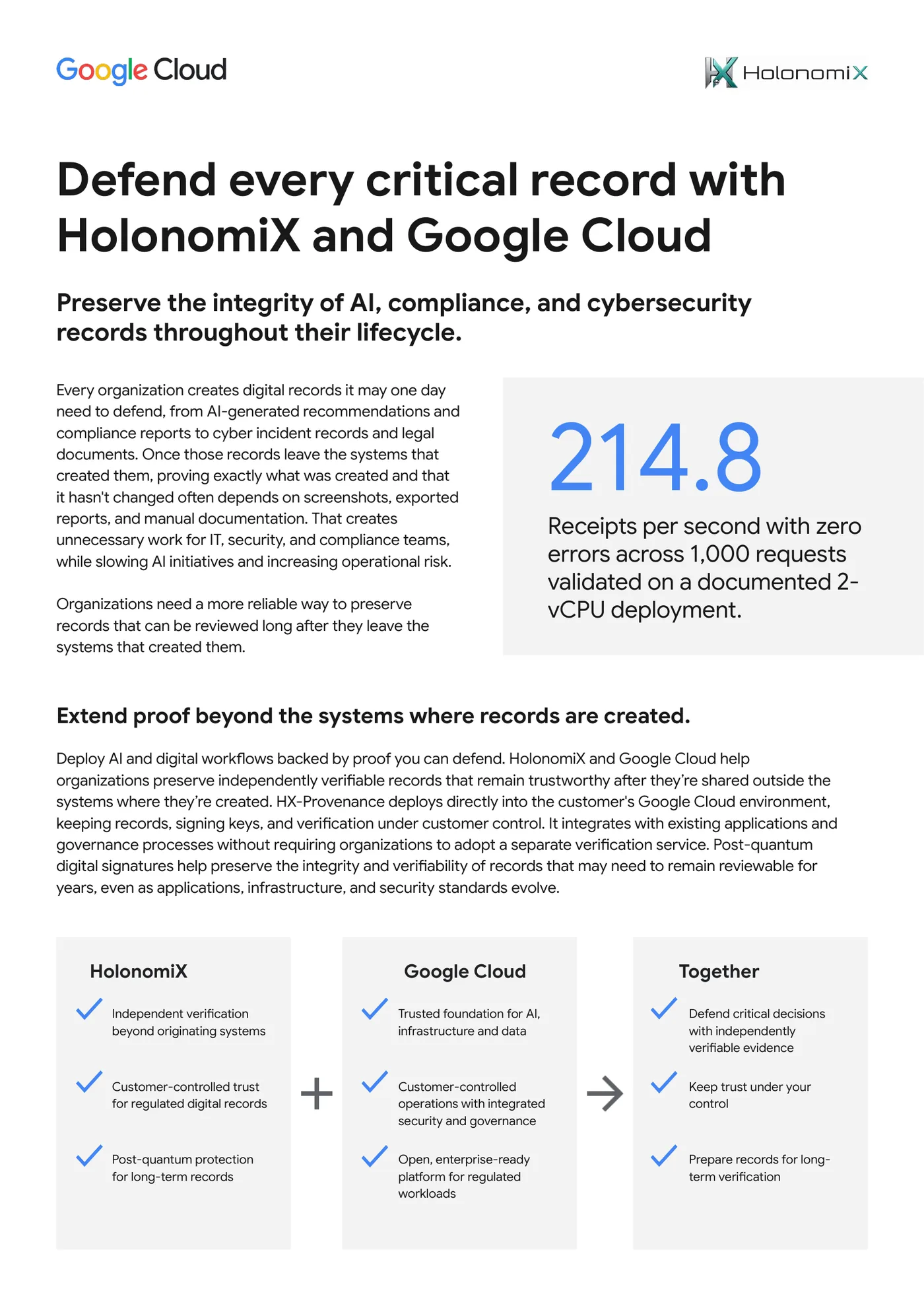
HolonomiX and Google Cloud help organizations preserve independently verifiable evidence for AI outputs, compliance records, cyber incident evidence, legal documents, and other business-critical records. Authorized reviewers can validate those records without relying on the systems where they were created.
HX-Provenance deploys inside the customer's existing Google Cloud environment. Records, signing keys and evidence storage remain under customer control, fitting into existing governance processes and applications.
Post-quantum digital signatures support verification after the originating system has been upgraded, migrated or retired. Retained evidence, the matching verifier and the expected issuer key provide the path for later review.
The joint solution brief reports 214.8 receipts per second across 1,000 requests with zero errors on its documented 2-vCPU deployment.
HX-Provenance and HX-Provenance for Vertex AI have separate Google Cloud listings. HX-Provenance is also deployed through AWS Marketplace. Trial eligibility and terms are specific to each listing.
Each engagement defines the workload, deployment boundary, acceptance criteria, evidence package and next commercial decision before execution. HX-SDP is available through a Private Appliance or scoped pilot.
| Product | Availability | Access |
|---|---|---|
| HX-SDP | Private Appliance · Scoped pilot | Request HX-SDP access |
| HX-Provenance | Google Cloud · AWS · Private Appliance · Scoped pilot | Deployment options |
| HX-PQC | Private Appliance · Scoped pilot | Contact HX-PQC sales |
| HX-AIFactoryTwin | Private Appliance · Scoped pilot | Discuss a thermal analysis |
| HX-MDAO-TP | Scoped pilot | Request an MDAO pilot |
| HX-AEIR | Google Cloud Marketplace · Private Appliance · Scoped pilot | View on Google Cloud Marketplace |
| HX-Fusion | Local runtime release candidate · Scoped integration | Discuss HX-Fusion integration |
Commercial availability, technical performance, product status and verification are different forms of evidence. Each remains attached to its own scope and supporting record.
Measured results carry the workload, hardware, precision, baseline, methodology and limitations that produced them. Receipts, manifests, bundles and validation records provide an inspectable path from a claim to its supporting material.
Signing, custody and verification requirements are stated per product. Published records and gated proof packs remain identified in the evidence registry.
The public demonstration contains a fictional record, its signed receipt, an evidence bundle and matching standalone verifiers. It exercises valid inputs, altered records and an incorrect issuer key. Verification runs offline after dependency installation.
This synthetic example demonstrates the mechanism. A valid signature establishes integrity under the expected key; it does not establish that the record's contents are correct.
Data, memory and compute form one economic system. HolonomiX begins with the form of the data before execution starts, because representation determines how much state a system stores and expands for computation, how often it must move, and where useful operations can act.
The same data can create different demands on memory and compute. A representation that exposes useful structure can reduce stored state and support operations without expanding the full object. The benefit depends on workload structure, operation, fidelity requirements, representation rank and deployment conditions.
| Property | Dense representation | Structurally aware representation |
|---|---|---|
| State | Explicit values in dense arrays. | A representation that uses the workload’s sparsity, low rank or other structure. |
| Memory movement | Determined by array layout, access patterns and the operation. | Can decrease when locality or compact state avoids moving unnecessary data. |
| Computation | Dense kernels act on the materialized arrays. | Supported operations act on the chosen representation without expanding all of it. |
| Scaling | Storage follows the dense array shape and precision. | Storage and work follow the retained structure and its overhead. |
Decide how much serving state to materialize, what the inference data plane costs to operate, and how retrieval-dependent outputs are evidenced.
HX-SDPEvaluate designs and thermal scenarios before committing capital, with validity and convergence states that remain inspectable.
HX-AIFactoryTwin · HX-MDAO-TPDecide what to migrate, in what order, and how to demonstrate posture to reviewers across the post-quantum transition.
HX-PQCPreserve records that must remain independently verifiable after the originating application, vendor or infrastructure is gone.
HX-Provenance · HX-AEIRReconcile changing inputs, retain uncertainty and contradictions, and identify what further evidence is needed before a supported answer is possible.
HX-FusionWatch product demonstrations, evidence walkthroughs and technical briefings. Follow deployment milestones, partner developments, representation research and commercialization through HolonomiX Field Notes.
A defined technical engagement can deliver a numerical component, a product integration, a private appliance or a custom application.
Numerical methods, GPU execution, operator design, thermal-fluid simulation and multidisciplinary analysis.
Representation-aware indexing, retrieval, persistence and integration for AI and analytical systems.
Discovery, migration planning, key custody, portable evidence and verification tools.
Deterministic data fusion, evidence-backed answers, APIs and custom applications.